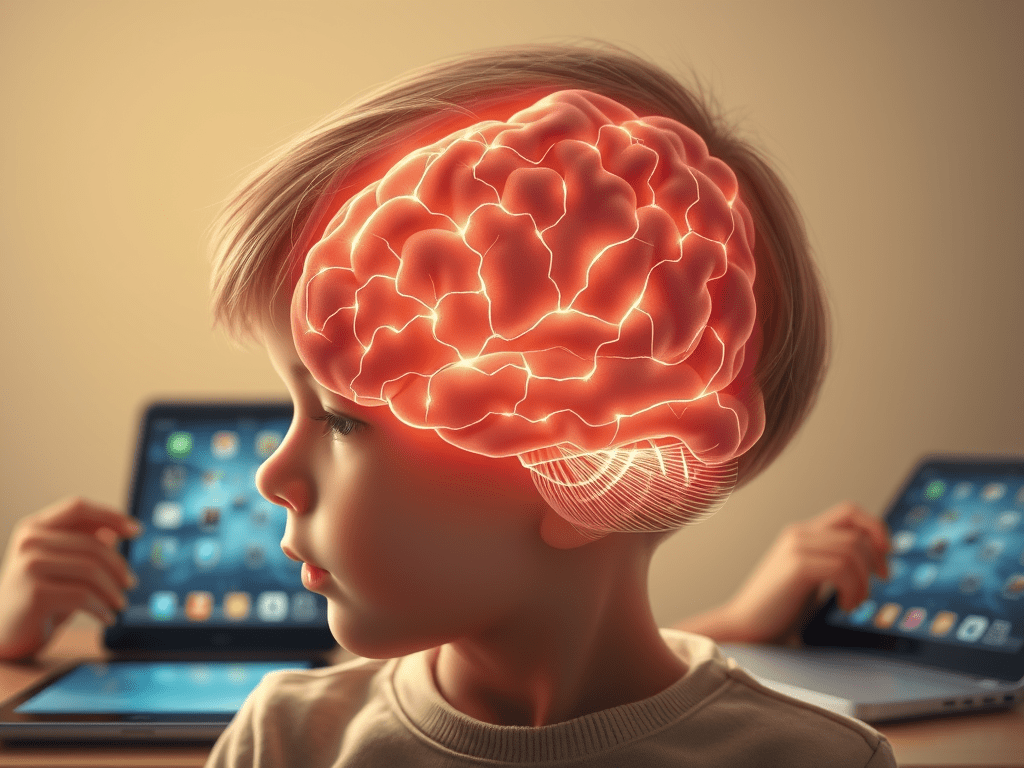
In today’s digital world, screens are everywhere. Smartphones, tablets, video games, and streaming platforms have become a normal part of childhood. Many parents have wondered for years whether too much screen exposure could affect their child’s developing brain.

Now, new research is beginning to provide some answers.
Recent brain imaging studies suggest that excessive screen time may be associated with changes in the development of white matter in children’s brains. These findings are raising serious questions among scientists, educators, and parents alike.
What Is White Matter and Why Does It Matter?
The brain contains two main types of tissue: gray matter and white matter.
Gray matter processes information, while white matter acts like the brain’s communication network, connecting different regions so they can work together efficiently.
You can think of white matter like the fiber-optic cables of the brain. When these connections are strong and well organized, information travels quickly between brain regions. This supports learning, emotional regulation, decision-making, and memory.
During childhood and adolescence, white matter is still developing. This means the brain is highly adaptable—but it also means it may be more vulnerable to environmental influences.
What Researchers Are Discovering
A recent study published in the medical journal JAMA Pediatrics examined nearly 1,000 children between the ages of 9 and 13. Researchers analyzed MRI brain scans alongside data about the children’s daily screen use.
The results were striking.
Children who spent more time on screens tended to show less organized white-matter pathways in certain parts of the brain. One of the key regions affected was the cingulum bundle, an important neural pathway involved in emotional processing and cognitive control.
In other words, higher screen exposure appeared to be linked with differences in how brain communication networks develop.
The Sleep Connection
Another important finding from the study was the role of sleep.
Researchers discovered that increased screen use was strongly associated with reduced sleep duration. Children who spent more time on screens were more likely to go to bed later and sleep less.
Why does this matter?
Sleep plays a critical role in brain development, memory consolidation, and emotional regulation. When sleep is disrupted, it can interfere with how the brain organizes and strengthens neural connections.
Scientists estimated that sleep disruption explained more than one-third of the connection between screen time and depressive symptoms in children.
Earlier Research Points in the Same Direction
This isn’t the first time researchers have seen a connection between screen exposure and white-matter development.
A previous study published in JAMA Pediatrics used MRI scans to examine preschool-aged children. Researchers found that children with higher screen exposure showed lower integrity in white-matter tracts related to language, literacy, and cognitive skills.
These findings don’t necessarily mean that screens directly “damage” the brain. However, they suggest that heavy screen exposure may influence how certain brain pathways develop during critical stages of childhood.
What Might Be Causing the Changes?
Scientists believe the issue may not be screens alone, but what screens replace in a child’s daily life.
For example:
• Outdoor play
• Face-to-face social interaction
• Reading and imaginative play
• Adequate sleep
All of these activities stimulate the brain in ways that support healthy development. When large amounts of time are spent on screens instead, those experiences may be reduced.
What Pediatric Experts Recommend
Health experts suggest practical limits rather than complete elimination.
General guidelines often include:
- Avoid screen use for children under 2 years old (except video calls)
- Limit screen time to about 1 hour per day for young children
- Keep screens out of bedrooms
- Turn off devices at least one hour before bedtime
Just as important, parents are encouraged to prioritize interactive activities such as reading, conversation, and outdoor play.
A Balanced Perspective
Technology itself is not the enemy. Digital tools can educate, entertain, and connect people across the world.
However, these new findings remind us that childhood brain development is incredibly sensitive to lifestyle habits. The choices families make about sleep, activity, and media consumption can have long-lasting effects.
As research continues, one thing is becoming clear: moderation and balance are key.
Children’s brains are still wiring themselves for the future. Protecting that process may be one of the most important investments we can make in the next generation.






Leave a comment